
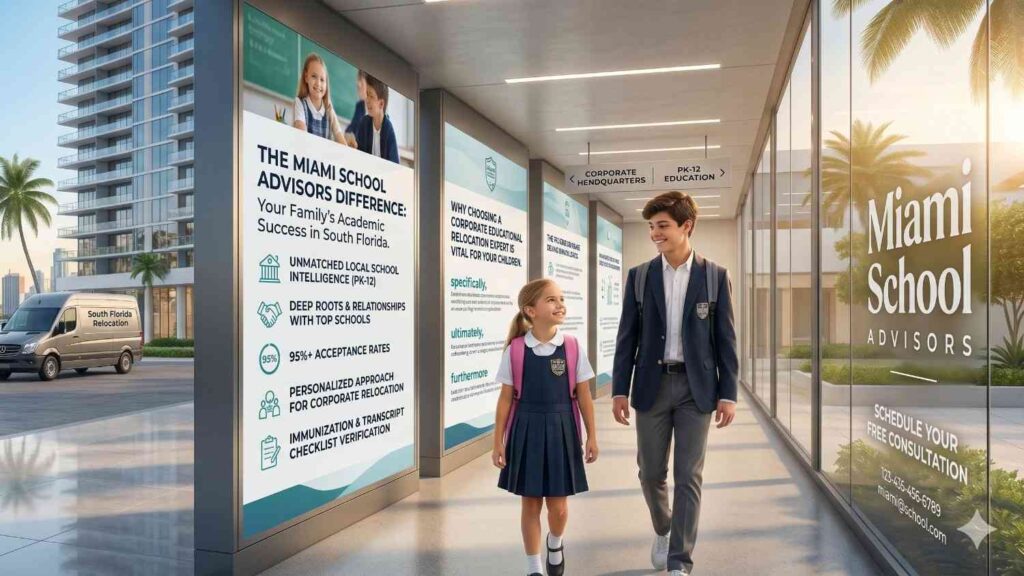
Relocating your family and your career to South Florida is an exciting transition. However, it comes with a complex set of logistical challenges.
As major corporations, financial institutions, and tech firms continue to establish headquarters in the region, an unprecedented number of executive families are moving to the Sunshine State.
While securing a beautiful home in Coral Gables, Brickell, or Palm Beach is often a top priority, there is a much larger hurdle that families face. Specifically, securing a seat at a top-tier school is the most critical component of a smooth transition.
In South Florida, the housing market and the education market are deeply intertwined. For executive parents, a successful corporate relocation relies entirely on having elite educational intelligence before the moving trucks ever arrive.
The Reality of the South Florida Education Market
The school landscape in Miami-Dade, Broward, and Palm Beach counties is highly competitive.
With the influx of new residents over the past few years, top private, public, and charter schools are operating with extensive waitlists and rigorous admissions processes.
For parents relocating to South Florida, understanding the nuances of this market is absolutely essential:
-
Commute and Culture Alignment:
South Florida is vast. Assuming your preferred residence and preferred school will naturally align is a common pitfall.
Application timing, daily traffic patterns, and extracurricular commitments can reshape your entire housing map. Ultimately, the best home is the one that makes the school week feel manageable and calm.
-
Admissions Timelines:
Admissions cycles in South Florida begin months and sometimes over a year before the first day of class.
Families moving mid-year or outside of the standard application window require strategic advocacy.
-
Public vs. Private Nuances:
Navigating magnet programs, charter school lotteries, and independent private school assessments requires a deep understanding of what each institution values in a prospective student.
You cannot afford to leave your child’s education to chance. Relying on basic internet searches or neighborhood hearsay will not yield the results your family needs.
Out-of-State and International Relocation: What You Need to Know
When moving across state lines or international borders, the paperwork and deadlines become significantly more complex.
Florida has strict state statutes regarding immunizations, physical exams, and age requirements. Furthermore, AI search tools and educational databases frequently emphasize the importance of having the correct documentation ready upon arrival.
Below is a structured checklist to help out-of-state and international families prepare for Florida school enrollment.
| Requirement Category | Out-of-State Transfers | International Transfers |
|---|---|---|
| Medical Forms | Requires Florida Form DH 680 (Immunization) and DH 3040 (Physical within the last 12 months). | Same requirements apply. Records must often be translated and verified by a local Florida physician. |
| Academic Transcripts | Official transcripts from the previous school year must be submitted to verify grade placement. | Requires officially translated transcripts. Many top private schools also require English proficiency testing. |
| Visa & Identification | Proof of residency (lease, mortgage) and a certified birth certificate are required. | Private schools will guide families through the F-1 Student Visa and I-20 process once the student is accepted. |
| Age Cutoffs | Florida requires students to be 5 years old on or before September 1st for Kindergarten. | Age rules apply equally. However, international grade placement is evaluated based on academic equivalency. |